

Property crimes in California are charged and prosecuted in criminal court based on the facts of each case. Allegations involving theft or other property-related offenses in Los Angeles County can carry significant legal consequences and require informed criminal defense representation.
Common Property Crime Charges in California
Property crimes encompass a wide range of offenses involving the taking, damaging, or destruction of another person’s property. In Los Angeles County, prosecutors aggressively pursue these cases, often seeking maximum penalties.
Theft-Related Offenses
- Petty theft (under $950)
- Grand theft (over $950)
- Shoplifting
- Receiving stolen property
- Appropriation of lost property
- Identity theft
Other Property Crimes
- Burglary (residential and commercial)
- Vandalism and graffiti
- Arson
- Trespassing
- Motor vehicle theft
- Embezzlement
Charged with a property crime? Don’t wait to get legal help.
Call for immediate assistance
Theft Offenses Under California Law
Theft is defined as the unlawful taking of someone else’s property with the intent to permanently deprive them of it. California law recognizes several distinct theft-related offenses, each with specific elements and penalties.
Appropriation of Lost Property (Penal Code 485)
Under California Penal Code Section 485, it is illegal to knowingly find and keep lost property without making reasonable efforts to locate the rightful owner. This offense occurs when:
- You find property that does not belong to you
- You know or have reason to know who the owner is, or can reasonably determine the owner
- You appropriate the property for your own use
- You fail to make reasonable efforts to return the property to its owner
Unlike other theft offenses, a conviction for appropriation of lost property is not considered a crime of moral turpitude, which can be significant for immigration and professional licensing purposes.
Legal Concepts of Possession
In property crime cases, prosecutors must often prove possession. California law recognizes two types:
Actual Possession
Occurs when you physically have the property on your person or within your immediate control. Examples include holding stolen items in your hands, pockets, or personal bag.
Constructive Possession
Occurs when you don’t physically have the property but have control over it or the right to control it. Examples include stolen items in your home, car, or storage unit that you control.
Petty Theft vs. Grand Theft
California classifies theft offenses based primarily on the value of the property involved:
Petty Theft
When the value of stolen property is $950 or less, the offense is classified as petty theft. This is typically charged as a misdemeanor punishable by:
- Up to 6 months in county jail
- Fines up to $1,000
- Probation
- Restitution to the victim
In some cases, especially for first-time offenders with no criminal history, petty theft may be reduced to an infraction or handled through diversion programs.
Grand Theft
When the value of stolen property exceeds $950, the offense is classified as grand theft. This can be charged as either:
- Misdemeanor: Up to 1 year in county jail
- Felony: 16 months, 2 years, or 3 years in state prison
Prosecutors have discretion to charge grand theft as either a misdemeanor or felony based on the circumstances of the case and your criminal history. This is known as a “wobbler” offense.
Certain types of property (firearms, vehicles, farm animals) may qualify as grand theft regardless of value. Additionally, theft directly from a person (such as pickpocketing) may be charged as grand theft regardless of the property’s value.
How Property Crime Cases Are Prosecuted in Los Angeles
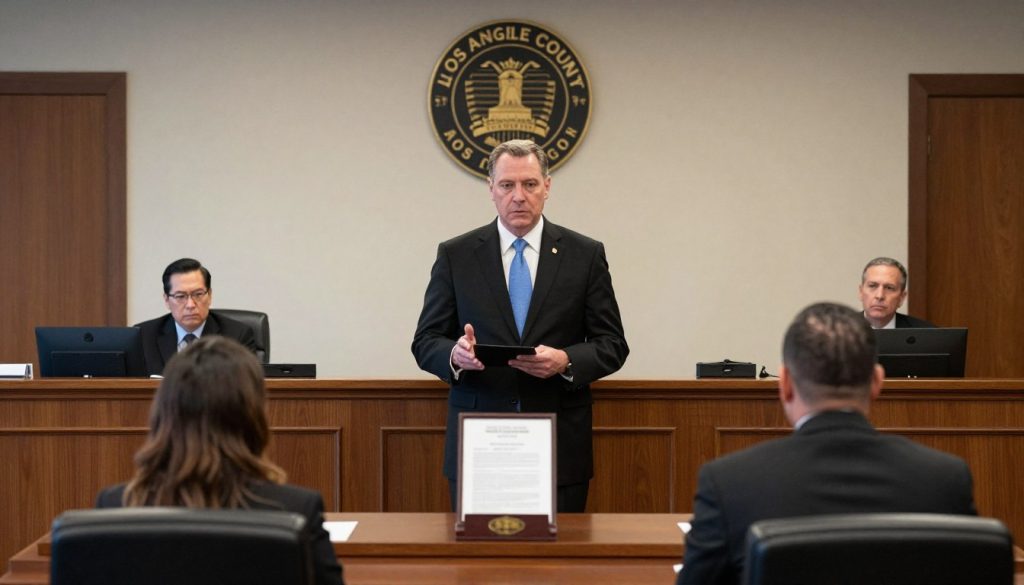
Property crime cases in Los Angeles County follow a specific prosecution path that begins with arrest and can culminate in trial. Understanding this process is essential to mounting an effective defense.
Investigation and Charging
After an arrest for a property crime, law enforcement gathers evidence including surveillance footage, witness statements, fingerprints, and recovered property. This evidence is presented to the Los Angeles County District Attorney’s Office, which determines what charges to file based on:
- Value of the property involved
- Method used to obtain the property
- Defendant’s criminal history
- Presence of aggravating factors (weapons, multiple victims)
Prosecution Strategies
Los Angeles prosecutors typically employ several strategies in property crime cases:
Evidence Collection
- Surveillance video analysis
- Forensic evidence (fingerprints, DNA)
- Tracking stolen property
- Cell phone records and location data
Witness Testimony
- Victim statements
- Eyewitness accounts
- Law enforcement testimony
- Expert witnesses (for value determination)

Prosecutors must prove beyond a reasonable doubt that you committed the property crime with the required intent. Our defense attorneys identify weaknesses in the prosecution’s case and challenge evidence that was improperly obtained or is unreliable.
Effective Defense Strategies for Property Crimes

A strong defense against property crime charges requires legal expertise and thorough investigation. Our criminal defense attorneys employ numerous strategies to protect your rights and achieve the best possible outcome.
Challenging Evidence
- Filing motions to suppress illegally obtained evidence
- Questioning reliability of witness identifications
- Analyzing surveillance footage for inconsistencies
- Challenging property valuation methods
Intent Defenses
- Lack of intent to steal or permanently deprive
- Belief that property was abandoned
- Mistaken ownership claims
- Good faith efforts to locate owner (for lost property)
Procedural Defenses
- Violation of search and seizure rights
- Miranda rights violations
- Chain of custody issues with evidence
- Statute of limitations defenses
Facing Property Crime Charges?
Don’t let property crime charges threaten your future. Our experienced criminal defense attorneys will fight to protect your rights and freedom.
Potential Penalties for Property Crimes in California
Property crime convictions in California carry significant penalties that can impact your life for years to come. The severity of these penalties depends on several factors including the specific offense, value of property, criminal history, and aggravating circumstances.
| Offense | Classification | Potential Jail/Prison Time | Maximum Fine | Additional Penalties |
| Petty Theft | Misdemeanor | Up to 6 months | $1,000 | Probation, restitution |
| Grand Theft (Misdemeanor) | Misdemeanor | Up to 1 year | $1,000 | Probation, restitution |
| Grand Theft (Felony) | Felony | 16 months, 2 years, or 3 years | $10,000 | Probation, restitution, strike under Three Strikes law |
| Burglary (First Degree) | Felony | 2, 4, or 6 years | $10,000 | Strike under Three Strikes law |
| Burglary (Second Degree) | Wobbler | Up to 1 year (misdemeanor) or 16 months, 2 years, or 3 years (felony) | $1,000 (misdemeanor) or $10,000 (felony) | Probation, restitution |
| Appropriation of Lost Property | Misdemeanor or Felony (based on value) | Same as petty or grand theft | Same as petty or grand theft | Probation, restitution |
Long-Term Consequences
Beyond immediate legal penalties, a property crime conviction can have lasting effects:
Professional Impact
- Difficulty obtaining employment
- Loss of professional licenses
- Barriers to certain career fields
- Background check issues
Personal Consequences
- Housing application rejections
- Immigration consequences for non-citizens
- Reputation damage
- Restricted loan eligibility
Why You Need an Experienced Property Crimes Defense Attorney

Property crime charges require specialized legal defense. The prosecution has significant resources at their disposal, and without proper representation, you risk severe penalties that could affect your life for years to come.
Case Evaluation
- Thorough review of evidence
- Assessment of police procedures
- Identification of constitutional violations
- Analysis of potential defenses
Legal Strategy
- Customized defense approach
- Negotiation with prosecutors
- Motion practice to exclude evidence
- Trial preparation when necessary
Case Resolution
- Charge reduction possibilities
- Diversion program eligibility
- Plea negotiation expertise
- Trial representation
Our criminal defense attorneys have successfully defended hundreds of property crime cases in Los Angeles County. We understand the local court system, prosecutors’ tactics, and effective defense strategies that get results.

Contact Our Property Crimes Defense Attorneys Today
If you’ve been charged with a property crime in Los Angeles, time is critical. Early intervention by our experienced criminal defense attorneys can make the difference between a conviction and a dismissal.
We offer confidential case evaluations to discuss your situation and explain your legal options. Don’t face these serious charges alone.


